The World Cup is 18 days away. I am giddy with excitement,
exacerbated by successfully picking up my tickets on Friday and the fact that
Brazil flags and bunting has started going up in shops and bars all over the
city. Finally, the fever is creeping in. But it is far later than normal, I’m
told. Usually, the decorations go up over a month before the World Cup’s
opening and Brazilians throw themselves exuberantly into everything that it
entails: parties, bank holidays and, fairly regularly, watching their country
win. But this year has been different. Delays and overspending, two things that
seem to happen at every major sporting event, have tarnished the build-up to
what should be Brazil’s moment in the sun. But unlike other major sporting events, protests by the local people have overshadowed the preparations even more. I don’t know how much has been heard
about them outside of Brazil, but here they are a really big deal.
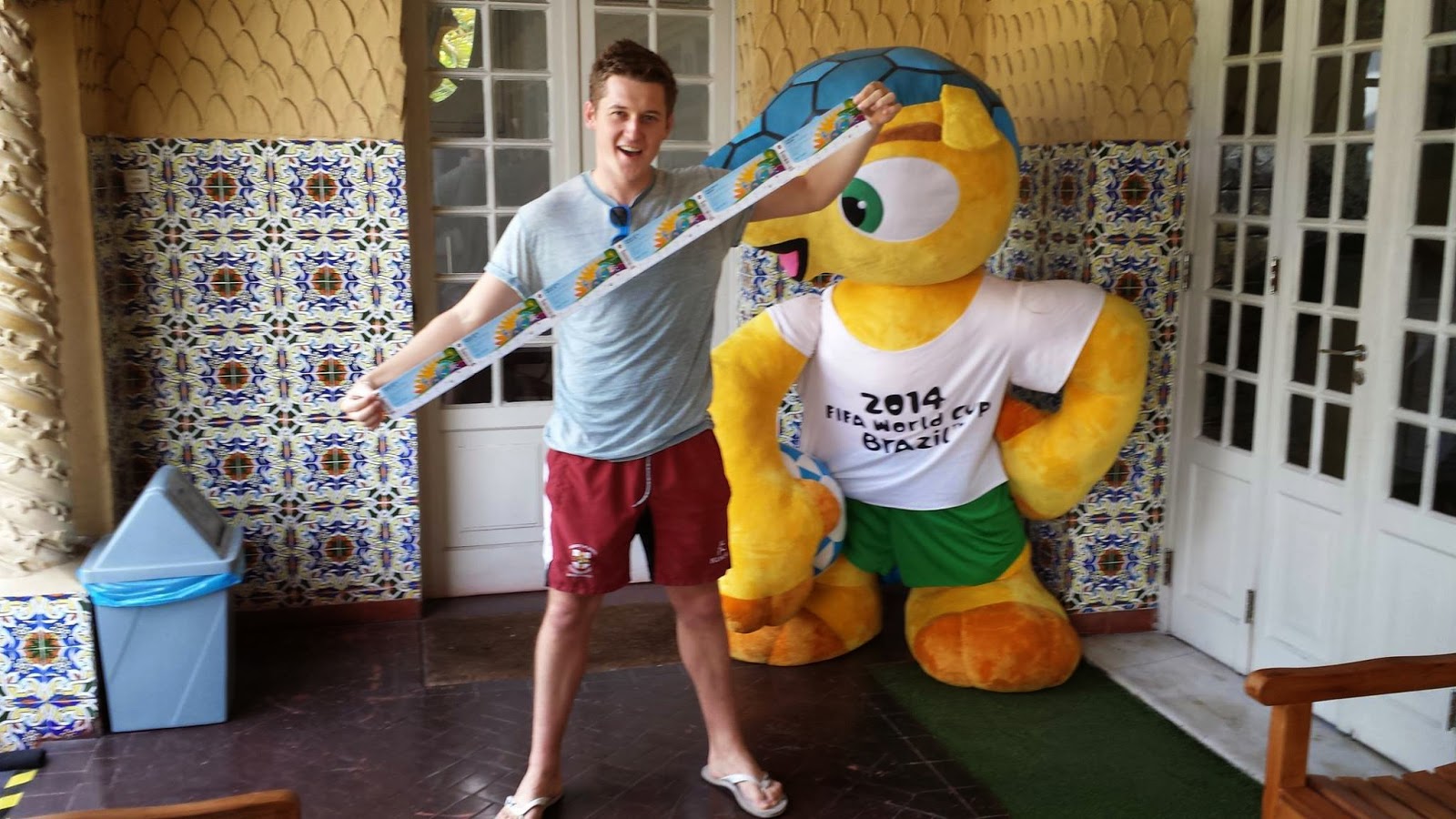 |
| A happy man with my World Cup tickets |
The main reason for the protesting, as far as I’m aware, is
that the government have spent billions of reais on the ‘Copa’. This is in a
country where social inequality is huge, millions are in poverty and basic
infrastructure can be painfully limited. However, you could arguably be
forgiven for thinking that the Brazilian public might see past the problems for
the reward of hosting the World Cup. I mean, Brazilians spend all day on the
beach, watching football or partying, right?
That’s the thing, they don’t. It’s true that football and
the beach are big parts of life in Rio de Janeiro, but far less than the
British media might have you believe. I find it very interesting to see that
all British advertising for the World Cup seems to be exclusively based in Rio,
just one of 12 cities to be hosting matches during the tournament. It is true that Rio is
the centre of the Brazilian stereotype and its picturesque landscape naturally
makes it the most appealing place to visit. But this is a huge country and
there is so much more to it, in terms of landscape and culture. In the next
month or so I will be visiting other places, but I won’t be scratching the
surface of what is on offer.
Someone who did ‘scratch the surface’ is Michael Palin, who
wrote a book and made a television show about Brazil. It’s a good read and
gives you a taste of the vast diversity in the country, but the picture it
paints is very positive, conforming to the stereotype that everyone here is
constantly delighted. I met Tim Vickery, the BBC’s South American football
correspondent, who said that Palin’s book is now almost irrelevant because so
much has changed in the couple of years since he wrote it. He would now have to
focus much more on the social unrest, protests against the Copa and the
government, as well as showing that not all Brazilians are ecstatic with their
current state of affairs.
 |
| Palin's Brazilian experience |
Vickery stated that there has never been a more fascinating
time to be here. The country is changing before our eyes, as the people realise
the power their voice can have. The general election takes place at the
beginning of October and there is a definite possibility that the World Cup
will influence its outcome. I believe there will be protests during the tournament;
it will be unavoidable. For that reason, pressure will be on those election
candidates to deliver what the people want, especially as the eyes of the world
will be on Brazil.
Looking specifically at the World Cup protests, it is easy
to see why people are so annoyed. The stadia have taken the brunt of the abuse.
The enormous delays in construction as well as the deaths of several workers
have attracted attention. And perhaps most irritatingly, these are all things
that the government could have avoided. FIFA suggested 8-10 stadia for the
tournament, but the Brazilian organisers decided to have 12 host cities, in
order to spread the tournament around the country. Several cities, Manaus and
Brasilia, for example, have no good club teams and it is unlikely that these
will ever reach full capacity again, except perhaps if Brazil were to play a
friendly there. As a result, no private companies have taken an interest in
funding the projects, meaning that all of the money has come from the
government and, therefore, the taxpayer’s pocket. Quite how FIFA agreed to this
is beyond me.
 |
| A protestor burns a World Cup sticker book |
Secondly, politicians and Ronaldo, the World Cup’s all-time
top goal scorer and a member of the 2014 World Cup team, have been talking about “o
jeitinho brasileiro”, which would translate as “the Brazilian way”. This refers
to the act of getting things done, but in a far more relaxed manner and
‘leaving everything to the last minute’ kind of way. Holding “o jeitinho
brasileiro” responsible for your arriving late to a party might be just about
acceptable, but for the construction of 12 stadia, not to mention drastically
improving public transport, airports, roads, hotels, public services and
security, it is ludicrous, quite frankly.
If anything, what the situation has demonstrated to me is
that England should be hosting another World Cup very soon. FIFA’s attempts to
spread the World Cup to Asia and Africa are all well and good, but Japan, South
Korea and South Africa are all dealing with the problem of stadia becoming
‘white elephants’. Brazil, even with its well-documented footballing traditions
will probably face the same problems. The decision to award Qatar the 2022
World Cup was a disgrace, but the one saving grace is that the Qataris have
enough money to throw at it, without feeling the wrath of the people. FIFA
needs to give the tournament to countries with footballing tradition that are
capable of managing it.
For Brazil, it remains to be seen how the Copa will pan out.
Stadia should be full and the public will get behind it, but I am certain the
ramifications of the protests will be felt. The country could even begin to
show the world that life here it is not just a samba-fuelled, football, 24-hour
beach party. Gone are the days where a World Cup win might make everyone forget
about the social problems. Whatever happens, the tournament should throw up a
few shocks.


